Thursday, September 10, 2015

Writing in the Kingdom of Bhutan

In late August fourteen adventurers left Bangkok, headed for the Kingdom of Bhutan.


We stopped in Kolkata but didn't get off, and not far past Mt Everest (yes this pic the real thing, not a mountain shaped cloud!) our small plane, imagining it was a helicopter, wound its way through a narrow steepsided valley (so close we felt we could reach out and touch the valley sides) and landed on the short runway at Paro airport.


Our guide Tenzin, tall, handsome and elegantly dressed in a traditioal goh, shook each of us by the hand and said in his slow, calm voice 'welcome to Bhutan.'


On the way to Thimphu, he took us to the famous chain bridge, one of 108 chain bridges built in the 1300s.


The river rushes beneath the chain mesh, not as easy as it looks to cross, but our gentleman guide was ready with a helping hand.


Thimphu is the capital of Bhutan and consists of a charming sprawl of houses and apartment buildings built along the Thimphu Valley. Mist hung low over the surrounding mountains giving the hill town a suitable air of mystery.


First stop was the Memorial Stupa, to join the locals in circumnabulation.


Next stop, the Takin Reserve.  The takin is the national animal and looks like a cow with a goats head. It is said that when asked to perform a miracle, local saint, Drukpa Kunley (see more below) took the head of a goat and placed it on the skeleton of a cow, and so the takin was born..


After lunch we browsed the local shops and craft market...


On the second day of our writing workshops we were joined by Bhutanese writers Chador Wangmo, Pema Gyaltsen and Karma Norbu, Namgay and Sonam. One of our group Carolina, told of her journey to Bhutan in 1968, when Mrs Ghandi came to open the first sealed road.

Postcard circa 1968

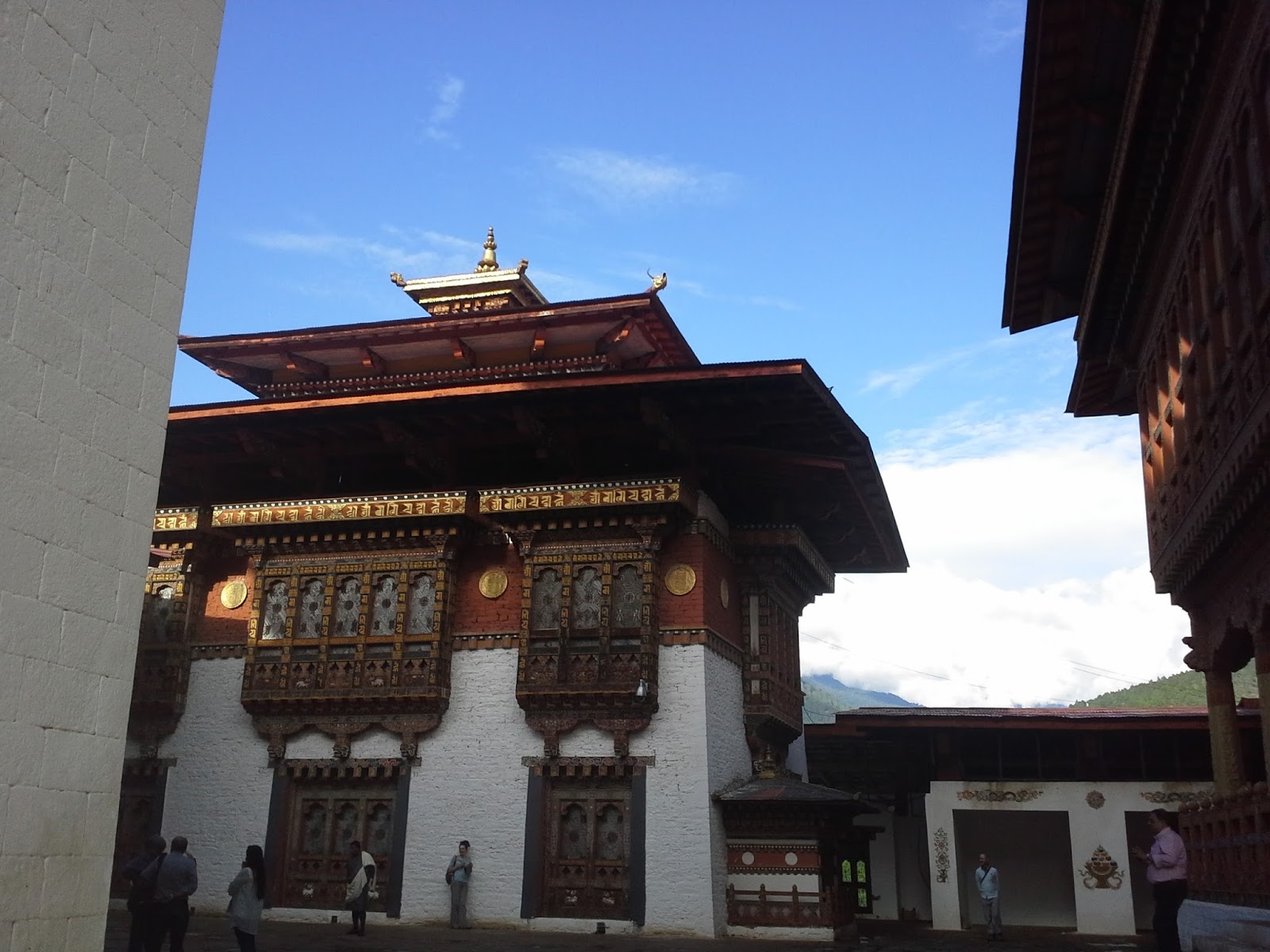
Some of the other sights we visited were the impressive Trashi Chhoe Dzong where monks were reahearsing their mask dances for the festival in Sept.


 And the sun broke through the misty clouds on our visit to the giant Buddha watching over Thimphu valley. In its final stages of erection it should be ready next year.


We were invited to come to Sonam and Pema's school to meet their students.


And we stopped in at a paper factory before lunch.


The Natonal Library was a treat...


But the highlight of the day was a visit to the School of Thirteen Arts. The college was is sponsored by the 5th King of Bhutan. Here tuition is free and  students are instructed in the major arts and craft skills. Read more here.


 On Day 4 we headed up and up along steep windy roads to Dochala Pass.


The pass was shrouded in mist so we missed the view of the Himalayas, but we could imagine...


We coasted down into the Punakha Valley to visit the temple of Drukpa Kunley, The Divine Madman. Known as a practioner of 'Crazy Wisdom' he loved women and ara (local wine) is still revered as an irreverant saint. Animated representations of his phallus adorn houses all over Bhutan as a symbol of fertility and women come from all over the world to take part in a fertility ritual at his temple.


At our new hotel, the glasshouse by the wide glacial river was the perfect spot for our workshops. More Bhutanese writers joined us, Karma, Dechen,  all teachers from the area.


Next day we visited the stunning Punakha Dzong, built at the confluence of the the confluence of the Pho Chun and Mo Chuu Rivers...


and hiked through the rice paddies to Khamsum Yulley Namgyel Chorten.


Inside was a treat for those of us who knew a little about Tantric Buddhism — four floors of  sculpted wrathful deities and wall paintings (no photos allowed), with a spectacular view over the valley from the top.


We all agreed we could have spent an extra day in Punakha Valley.


Back over Dochala Pass and on to Paro, we visited  Paro Dzong (no, we were not Dzonged out yet!)


And then checked into our red carpeted cottages at Olathang Resort. This was the first hotel to be built when Bhutan opened its doors to tourism in 1974, and it has lost none of its charm.

Day 7 and it was time for the climax of the trip, our hike to Taktsang Monastery, or the Tigers Nest, which is perched way up on a cliff side in the Paro Valley  and is where the legendary Guru Rinpoche (Padmasambava, who brought Buddism to Tibet and Bhutan) is said to have flown in on the back of a tigress and meditated in a cave there for three months.


It's an hour's steep walk to the teahouse and viewing point ( you can do this section on horse back) and then another hour to the monastery.


It's a great spot to view Tigers Nest and hikers have the option of continuing on to the next stage of the walk.


Paro Taktsang was shy at first, hidden in the mist.


But then the clouds parted and revealed her splendour.


At the end of the walk there are a thousand steps along the cliff face that take you down to the cave of Yeshe Sogyal ( Padmasambava's consort — it was she who transfomed her self into the tigress to bring him to this extraordinary place), and up to the Tigers Nest.


No gadgets allowed here either,  no phones, cameras, not even pens or note books. There is even a mantra singing police man to frisk you as you enter.


We arrived in the small gonpa that has been built around Guru Rinpoches's cave (we could see the door to the cave that is rarely opened) and thirteen monks an their lama were doing a long life puja for the Queen Grandmother (she is a great supporter of the Dharma). Chanting and sounding the trumpets, drums and cymbals —it really is a deeply primordial sound.  We visited other small temples, rang the big bell given to the monastery by the people of Kobe, Japan. Its sonorous tone sounded out across the valley and one could imagine the flight of the tigress with its valuable charge,  and its arrival  in the small gap in the rock our guide called the landing strip.


We lit butter lamps in a room next door and each made a wish. The lamps would burn on for 24 hours sending their smoke out into the mist that swirls around the Taktsang cliffs and up to the heavens.


Lunch time for the monks and the policeman  meant closing time for us so we picked up our things from the locker room and started the climb down. A few of us visited the cave of Yeshe Sogyal just below, no time limits there.


We said some more prayers and wishes at her altar and took note of the sign, Quiet Please Hermit in Residence. In a small closed room built above the cave we imagined and old nun sitting with her prayer wheel sounding out her mantras as everyone here loves to do; the chef at our first hotel, the doorman with his deep low timbre and the police man we had just left behind.


On the way down some of us found time to write


others practcally skipped down the track


and while we may have just experienced the highlight of our trip, we knew it wasn't over yet.

To be continued...

More pics here

Read some of our writing here

We will visit Bhutan again in August 2016 to attend the Mountain Echoes Literary Festival and explore the valleys we didn't get to this time. All details here.

Jan Cornall leads international writer's workshops and retreats. Find out more here


Tuesday, June 30, 2015

Women Writers in Turkey

While nobel prize winner Orhan Pamuk may be the only Turkish author many westerners are familiar with, I was happy to discover a wealth of other Turkish writers in local bookstores in Istanbul during my residency at maumauworks in June. I was drawn in particular to two short story collections by Turkish women: Istanbul In Women's Short Stories  (editor, Hande Ogut) and Europe in Womens Short Stories from Turkey, (editor, Gultekin Emre). Both are published by Milet Publishing.

Asli Erdogan

Sadly my friend Asli Erdogan was out of the country during my stay. I met her at a literary festival in Indonesia 10 years ago and would love to have caught up. She is on the wikipedia list of Turkish women writers along with popular authors Elif Åžafak and Buket Uzuner whose novels are best sellers in Turkey. However there are many other authors not included on this list like writers Naz CuguoÄŸlu, Sine Ergün and Gönül Kıvılcım who I met at maumauworks during my stay.

Naz CuguoÄŸlu

Naz  CuguoÄŸlu is a short story writer who has been writing since she was young. She used to write memoir but now prefers the short form. Her magic realist stories centre on male characters dealing with everyday issues. A graduate in social psychology she has volunteered in culture labs in Turkey, Nicaraguara and the US. She has worked in an Istanbul-based gallery and frequently contributes reviews and interviews to publications like Istanbul art news, Artful Living, Trendsetter or KLOK. Naz currently curates exhibitions and manages residencies at maumauworks. She recently took part in a writer's residency in Barcelona.


Sine Ergün  the founder of maumauworks, also likes magic realism and Raymond Carver. Her stories are about the small details of life. She has published two short story collections,  and  and is part of an anthology edited by


Gönül Kıvılcım has published a number of novels and written for magazines, online journals and the theatre. She lived and worked as a journalist in Germany for many years before returning to Istanbul to live. After returning home she worked at Channel 6 and Radikal. Her books are:
"Small Town Lies", Life Publications, 2001, "Razor Boy.", Life Publications, 2002, "Partially Love"  Everest Publishing, 2004, "Karakoy The Living Witness", Heyamola 2010, "Crime Palace" Support Verlag, 2011, " Dad's Best Photo " Detail Publications,  2012.

Gönül brings a journalists's sensibility to her work, dealing with issues of homelessness and street kids in her novel, Razor Boy, and the stories of ordinary people in Small Town Lies. Her fourth novel which she spent a whole year researching, will soon be finished. Gönül is passionate about writing,  telling me she takes over every corner of her apartment pinning notes and paper to the walls. She doesn't mind the lonlieness of the long distance writer either. You have to be alone to write, she says. When I have a bad day, I just read.


I took Gönül's advice and when the writing wasn't flowing I disappeared into the two collections I had bought. In fact for a while, day became night became day, as I couldn't stop reading. I read Europe first and next Istanbul, and was glad I had this smorgasbord of women writers to dive into.


Mine Sogut

One of the reasons I wanted to read Turkish women writers was that on the street (especially my street which I renamed, Yelling Street), Turkish men are the dominant presence, and I longed to know where the women were, what they were doing, what they were thinking and feeling. These two volumes containing women writers of varied ages and varied writing styles gave not only answers, but connected me with feminine insights so exquisitley expressed I was able to recognise a shared experience of womanhood while appreciating the huge cultural difference between us. It was as if I was reading the stories of sisters from whom I had been separated at birth.

Susan Samanci

My favorite authors are Erendiz Atasu, Susan Sumanci and Mine Sogut.Gonul has a story in Istanbul as well. Gaye Boralioglu's story about a working woman who watches her husband gasp and die on the long train trip home from work, and just gets off the train without him, is stunning. As is Erendiz Atasu's story of a woman making love to a gondolier. There's strength and fragility in the writing of all these stories, a tender eroticism and power, humour and irony, and there is no better way to get to know a city than through its literature.And they give a nice balance to the melancholy of Pamuk's writing. A friend warned me against reading Pamuk while I was here. She said she had read his novel Snow before she went and couldn't shake the feeling that it was haunted by the ghosts of empire. There is no risk of that in these stories. While melancholy may weave its way through some of the narratives, it is always imbued with the practical realism of a Turkish woman's point of view.

Erendiz Atasu


The foreward to the English version of Istanbul by translators Idil Aydogan and Patricia Billings states...

"This collection does not present its reader with an idealised Istanbul, where East meets West. Rather Istanbul is a place where over the centuries East and West have engaged in a testy relationship, pushing and pulling, repelling and attracting with the ebb and flow of the Bosphorous, leaving its inhabitants in a constant struggle — a struggle for their identities, those they express for all to see and those they feel inside.

 With contributors born mainly between 1940 -1970 who are not just Turkish but Greek, Kurdish and Armenian backgrounds this collection represents the works of different generations and cultural groups."

I cannot sign off without mentioning the excellent team of translators in both volumes. Without them we foreigners would miss the great pleasure of losing ourselves in these stories.   

Watch a fanstastic talk on You Tube by Patricia Billings "Turkish Literature in Translation"
Recent Developments, Ways Forward and Global Trends, given at the London Book Fair in April 2015.


Jan Cornall was writer in residence for three weeks in June 2015 at Maumauworks in Istanbul.
Her residency was funded by CAL, The Copyright Agency.
Many thanks to Naz and Sine from Maumau, and to CAL for a great residency!

Jan leads international writer's workshops and retreats. Find out more at www.writersjourney.com.auhttp://www.writersjourney.com.au/


Pamuk's Istanbul and my Garage of Memories

On the day I arrived at maumauworks in Instanbul for my three week writers residency, Sine (maumau founder) and Naz (maumau administrator) told me about the Museum Of Innocence. It's just nearby, they said. Have you read the book?


I'd been reading Orhan Pamuk's book Istanbul in preparation for my trip, but hadn't heard of his novel The Museum of Innocence which was written only after he started collecting for his museum.

Sometimes you have to travel half way across the world to receive a special book recommendation, but I had no idea I would be able to enter the world of his novel is such a tangible way.


I'm always reminding my students of the importance of creating the world of their stories, suggesting they make a scrapbook or collect objects in a bag or a box. I did this even before was a writer and still do. I have a garage full of secret caches stashed a way containing pieces of fabric, old letters, trinkets, photos, postcards, keys, fragments of soap, empty perfume bottles, rings, cufflinks, my father's psalm book, my mother's sheet music, my childrens umbilical chord clips, and so on. The bags and boxes line the wall draped with various collected pieces of Japanese, Rajastani and Batik cloth. Some of my mothers paintings are there and a couple of Matisse prints torn from a calendar that used to hang in her kitchen. Random things too like an America Indian headress from a costume shop, some antique wayang kulit puppets, a naked shop dummy strung with leather belts, a moth eaten Chinese parasol.

In the middle I've set up a large work table, big enough for six or eight people to sit around, where I sometimes hold petite bookmaking workshops, but mostly it's a place where I go to order my thoughts, to rustle about, to move memories around or to muse on my next creative project.


While some might want to call my collecting habits hoarding, I always defend myself, muttering about the importance of archiving, referencing, keeping creative materials on hand etc. but since visiting Pamuk's museum and reading his novel, I am able to understand something new about my garage of memories.


Pamuk says in an interview for the Huffington Post...

"The habit of collecting, of attachment to things, is an essential human trait. But Western civilization put collecting on a pedestal by inventing museums. Museums are about representing power. It could be the king's power or, later, people's power.....In my novel, where (the protagonist) Kemal collects the tea cup, cigarette butts, bedroom door handle and other items of Fusun, he is building a museum not to power but to the intimate experience of love, to an individual life. My point is that, whatever a life is made of, its dreams and disappointments, is worth taking pride in."

If you haven't read the novel here's the blurb...

"It is 1975, a perfect spring in Istanbul. Kemal and Sibel, children of two prominent families, are about to become engaged. But when Kemal encounters Füsun, a beautiful shopgirl and a distant relation, he becomes enthralled. And once they violate the code of virginity, a rift begins to open between Kemal and the world of the Westernized Istanbul bourgeoisie. In his pursuit of Füsun over the next eight years, Kemal becomes a compulsive collector of objects that chronicle his lovelorn progress—amassing a museum that is both a map of a society and of his heart. Orhan Pamuk’s first novel since winning the Nobel Prize is a stirring exploration of the nature of romance."

In the Huff Post Pamuk goes on to say...

"In building my own museum in Istanbul, I am very close to my character Kemal. I don't want to exhibit power but express my interiority, my spirit. A museum should not be flags--signs and symbols of power--but intimate works of art. It should express the spirituality of the collector. "

 He adds...

" I identify with Kemal's attention as a lover to his beloved because it is like a novelist's attention to words. In the end, being a novelist, in a way, is loving the world, caressing the world with words. It is paying attention to all the details that you have lived and experienced. This book is my most personal, intimate book. It is all the things I have lived and seen in Istanbul in my entire life. It is a panorama written with loving detail."

"At the age of 60 I am less experimental and more mature. I want most of all to convey my understanding of life. And writing novels for 35 years has taught me great humility. It has taught me to be respectful of how marvelously detailed the world is. Again, this is very close to a lover's attention to his beloved's every movement, her gestures, angers and silences. To notice everything is to care for it.

There is indeed a kind of Sufi or Pan-theistic quality to this love for the world, as is also suggested by Buddhist mindfulness."


My apolologies for pulling out such lengthy quotes from the interview, but so much of what Pamuk says about life, love and writing is immensely inspiring and validating.


Visiting his museum has helped me understand the peace I feel deep in my garage surrounded by the memorabilia of my life,  and why as much as I try, I can't throw my bits and pieces away yet. As Pamuk says, they are a touch stone to all the ways one has lived and is still living; a life filled with all its happinesses and sadnesses,  all its successes and dissapointments.

I enter my garage in a different way since returning from Istanbul. I view my objects with more love. The tinge of shame is gone. I'm thinking to make an inventory. If I don't have time to tell each story I can at least give each object a line. Instead of having a garage sale, I'm thinking to have a viewing time, maybe on Sunday afternoons. I can serve tea and scones, on the family china that sits in a box at the bottom of one of the stacks.

Yes, that's what I'll do, I'll let you know when.


Read a Guardian review of the novel Museum of Innocence here.

Read all about the actual Museum of Innocence here

If you can't get to Istanbul, the book Pamuk has written about the museum, The Innocence of Objects, is almost as good as the real thing. It details the background to the museum project and takes you through the exhibits chapter by chapter with excellent photos and excerpts.

Read about other Turkish authors I discovered in another great book by contemporary Turkish women writers, - Istanbul in Women's Short Stories. 


Jan Cornall was writer in residence for three weeks in June 2015 at Maumauworks in Istanbul.
Her residency was funded by CAL, The Copyright Agency.
Many thanks to Naz and Sine from Maumau, and to CAL for a great residency!

Jan leads international writer's workshops and retreats. Find out more at www.writersjourney.com.auhttp://www.writersjourney.com.au/
Creative in Bhutan, Aug 29 -Sept 7


Tuesday, May 12, 2015

Creative Spirit

When the weather turns cold and winter fires start to crackle, it is a perfect time for igniting your creativity. This chilly season three artists bring their creative skills together at Namgyalgar South Retreat Centre, nestled on the southern slopes of Mt Gulaga near Central Tilba.


Painter Glenda Morgan, writer Jan Cornall and movement artist Suze Smith, will add meditation to the creative mix when they lead their weekend retreats for residential or daily participants. In between delicious food, warm fires, envigorating walks, meditation and movement sessions, there will be a chance to play with colour and line, movement and dance, poetry and sensual story telling. 


 Evenings will be filled with stimulating discussions, performance soirees, video talks, laughter and hot-water bottle dreaming. Its a mid winter opportunity to spend a long weekend with like-minded spirits in a winter green mountain hermitage and to keep the creative conversation going long after you return home.


Two weekends are planned: Creative Spirit, on June 26,27,28, a long weekend exploring writing, painting and meditation, and Mind Body Movement, on July 17,18,19, a weekend opportunity to uncover organic pathways of movement through improvisation, directed touch and embodied anatomy.

 Your workshop leaders, all members of the Dzogchen Community (following the teachings of Tibetan Master Chogyal Namkai Norbu) have been practicing meditation for many years and are well established in their own artistic practice.


Chogyal Namkhai Norbu in a playful mood at Namg South, 1990s. 
 Your Tutors

Glenda Morgan has been painting and exhibiting for 25 years and has taught drawing, printmaking and design at Universities and art schools in Sydney She is a certified instructor in Qigong and Tai Chi.

Jan Cornall is a published writer who has written plays, screenplays, musicals, a novel, short stories, travel articles and songs.  She has an MA in Cultural and Creative Practice, has taught writing at universities in Australia and Indonesia and leads international writing and creativity retreats. 

Suze Smith is a contemporary theatre maker and somatic movement teacher. She is a dance artist, writer, director and lighting designer. Her theatre making practice is informed by her ongoing study of post modern dance and improvisation, embodied anatomy and Body-Mind Centering®.

Retreat details

3 Day Residential Retreat

Cost: $300 (Friday 2pm to Sun 4pm)
2 nights accom + all meals
Accom in private caravan, dormitory, camping. (B&B accom off land can be arranged at extra expense)

Or Attend 1 Day workshop
Cost: $90 (9.30am to 5 pm+lunch)

Bookings:

E: glenda.energyarts@gmail.com
P: (02)6493 4417


Make plans for warming up your winter now!


Thursday, April 23, 2015

First Page to First Draft

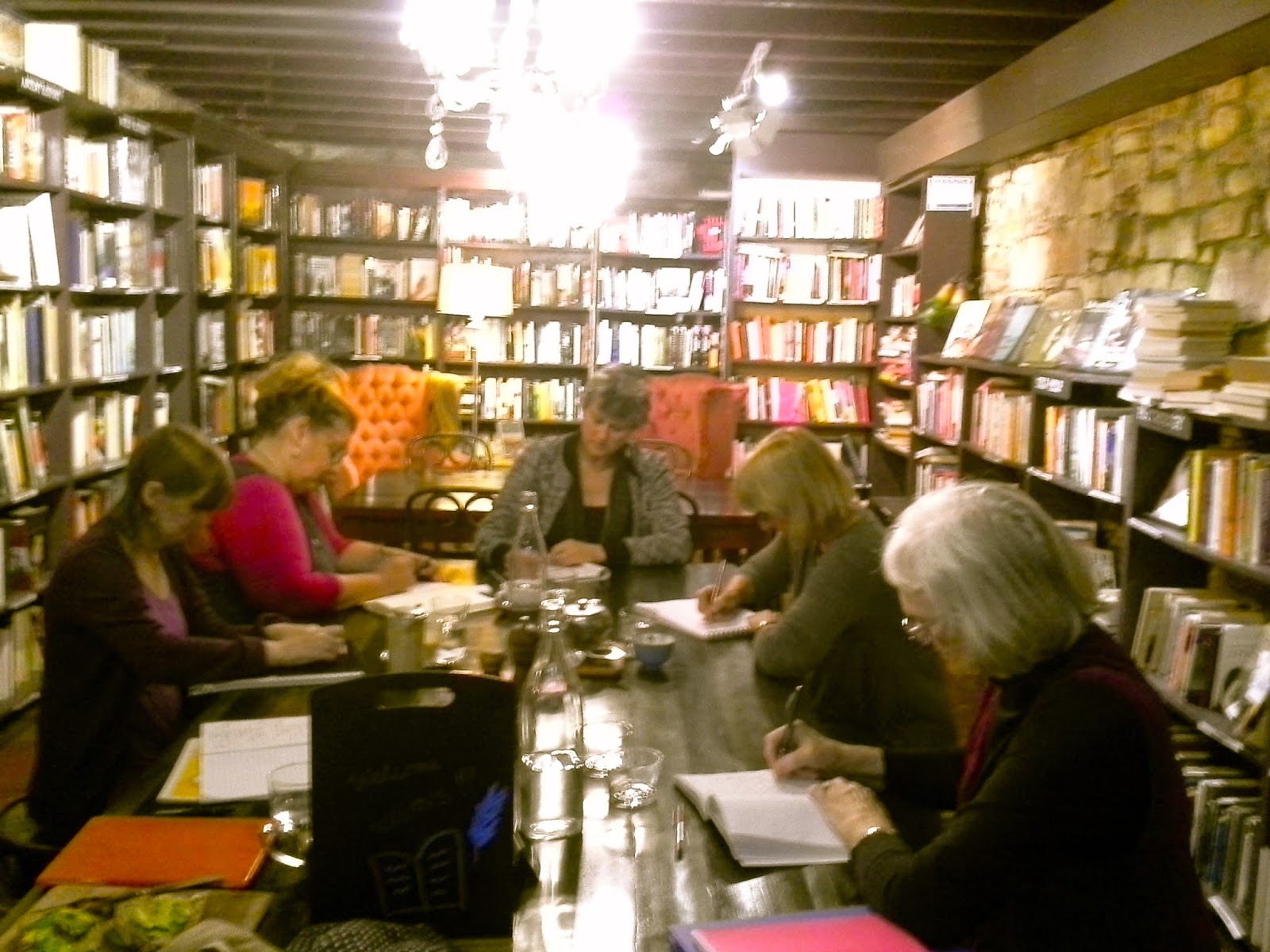
Semester One, First Page to First Draft, began this week in the book cave at Ampersand Cafe and Bookstore in Paddington.


I arrived a bit early, around 10 am, and there was a man reading a blue book in the winged arm chair at the end of the room. (Did I mention he was handsome? I thought at first it was Rupert Arrowsmith who I had met only weeks before at the Irrawaddy Literary Festival in Burma. But how could that be, he was now in New York). Next time I turned around he was sleeping, head resting on the wing of the chair, book on his tummy, an absolute picture of peace.

I hoped he might stay that way well into our workshop, then wake up and join us, but sadly after twenty minutes or so a waiter touched him on the shoulder to ask if he would like something else to drink. I guess they have a no-sleep-while-reading policy. But it got me thinking, what a good idea! Like the hammock cafes in Vietnam only you get a book as well as your hammock and fresh coconut!

I invited him to stay but he said he had to be somewhere and that it had been a perfect nap. I took it as an auspicious beginning to our workshop series.


Soon the writers arrived and after hearing about their writing projects we got down to some serious writing. Three memoirists, two poets et moi. (I'm not sure what I'm writing next but it will probably be memoir based). Oh, and Roscoe the seeing eye dog, who was under the table. I will get a pic of him next week!  Samantha, one of my ex students from UWS (left below), is vision impaired and Roscoe comes along to help her find her way. He sat on my feet most of the workshop and I have to say I did enjoy it. Lets add dog foot warmers to the hammock cafe idea!


Then I invited people to read and we had a tantalising taste of what's to come over the next five weeks. People's stories are just so fascinating. I can't wait to hear more!


First Page to First Draft is run in three modules over nine months, designed to give you the opportunity to finish your draft by October. You can join any time. Read more here.

Wednesday, April 22, 2015

Writing Among the Ruins - Angkor Wat

In March 2015 our group of writers met in Siem Reap for our Temple Dreaming Retreat.


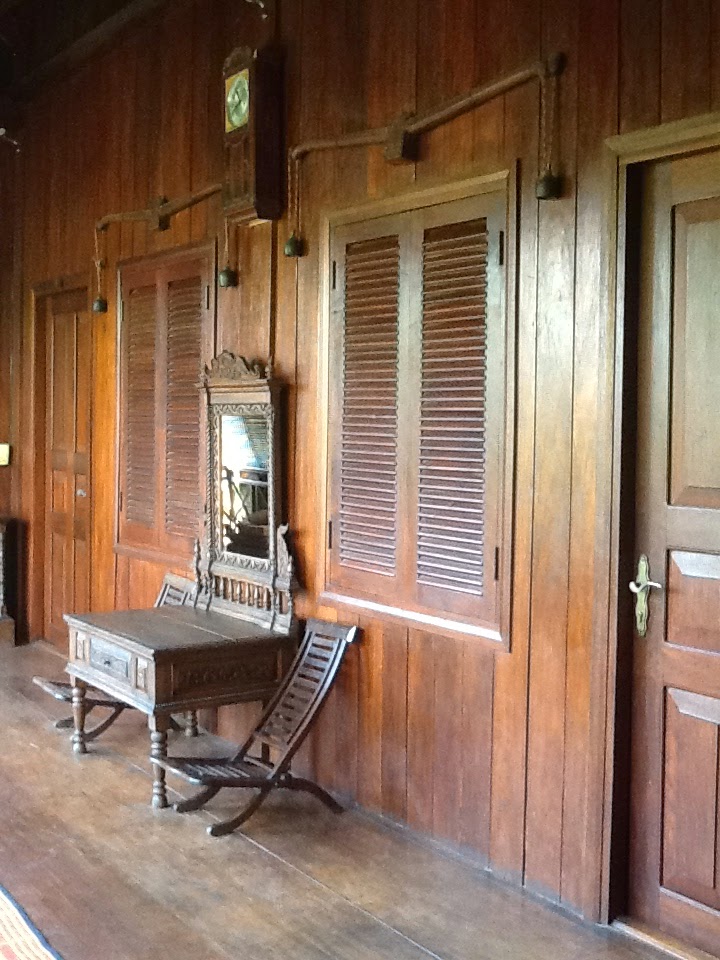
Our base was Villa Loti, a traditional guest house by the river, five mins by tuk tuk from the heart of town.


Mornings were spent in the ruins exploring some of the lesser known sites out of town.


Halfway through the week we had a workshop with guest tutor, comic artist and illustrator Louie Joyce on the art of visual story telling.


Walter Mason flew in from Vietnam and artist Chhai Kakkada from Battambang arrived in time for happy hour evening readings at Raffles and the Hyatt.


Our preferred mode of travel was by tuk tuk of course!


Though it looks like we were on holiday, lots of work was acheived, with breakthroughs a plenty!


Merci beaucoup to our Villa Loti hostesses, Jade and Anne who so charmingly looked after all our needs.


Read blog posts by some of our participants:

Rob Schneider

Why You Should Attend an Expat Writers Workshop

A Holiday In Siem Reap

Diana Plater

Sounds of Silence

Coming up next with Writers Journey 

Backstage Bali, July 11-18
Creative In Bhutan, Aug 29-Sept 7
Moroccan Caravan, Feb 20 - March

Thursday, April 2, 2015

The Third Irrawaddy Literary Festival

The third Irrawaddy Literary Festival (March 28-30) in Mandalay, Burma, may have drawn smaller crowds than the first two, but as the saying goes, it was quality not quantity. If you were lucky enough to be there as I was, you would have been party to one of the most intimate festival experiences possible. Like the early days of the Ubud Writer's and Reader's Festival, it felt as if you had portalled into the heart of a warm and friendly literary family as you rubbed shoulders with Booker Prize Winner, Anne Enright, had a drink in the bar with best selling author, Louis de Bernieres and got to know some of Burma's top poets, short story writers, novelists and journalists.

Rupert Arrowsmith adresses the crowd at the opening ceremony.

Sadly festival patron Daw Aung San Suu Kyi, on doctor's orders, wasn’t able to join this year, but her well wishes and presence were keenly felt. Despite her absence, in the setting of the Mandalay Hills Resort at the foot of the famous Kuthodaw Pagoda, there was an air of relaxation and friendship, as the crowd moved between simultaneous sessions running throughout the day. With around 100 Burmese writers present including both Yangon and Mandalay groups (Mandalay writers boycotted the festival last year), and a line up of 30 or so western writers, it wasn’t possible to catch everyone though we did our best.

Traditional dance at the opening ceremony.

Here are some highlights...

Rupert Arrowsmith's talk on The Face of The Buddha gave a big ‘aha’ moment as he described the work of William Empson in uncovering asymmetry in Buddhist iconography. Poet Joseph Wood’s presentation on fellow Irishman Maurice Collis and his writings about Burma in the 20s and 30s and Barnaby Phillips talk on his book, Another Man’s War were similarly fascinating. An hour with Burmese women writers, Phyu Mon, Lae Win Kyi Cho, Hnin Wai Nyein on the Sound Of A Poem,  was insightful and emotionally powerful, particularly the poem read by Kyi Mwe Eain dedicated to the young people injured and imprisoned in the most recent student demonstrations at Letpadan.


Burmese women writers discuss The Sound of A Poem.
An enthusiastic band of young student volunteers were manning all sessions and providing translations via ear piece, Burmese to English, English to Burmese. Burmese writers were discussing such topics as Worlding Burmese Literature, Narcotics in Literature, Myanmar Literature and Media Freedom. In the session before mine, Kyaw Saw Min (journalist and vet) was giving a talk on the Poems of Min Thuon. His audience, a group of Burmese women writers promised to hurry back from lunch to hear me perform my Love Songs to Indonesia. What kind of translation they heard in their ear pieces, I will never know, but when I tried out a love poem written during my last visit to Yangon they seemed to approve.

Some of the fabulous volunteers.

In the non-Burmese corner, a good number of countries were represented: Ratna Vira ( India) spoke with Anne Enright (Ireland) about her best selling debut novel, Daughter By Court Order. Siddarth Dasgupta (India) discussed his novel Letters from an Indian Summer alongside Sweden’s Helena Thorfinn (Sisters by the River) and UK’s Rosalind Russell (Burma’s Spring). At the writer’s dinner on the lawns of the Jefferson Centre Library, I had the pleasure of meeting Japanese historian Natsuo Miyashita who went to University in the UK with Daw Suu and has remained close friends ever since, and Bathandwa Mcuba, a cultural activist from South Africa whose book, Creative Culture, presents a positive take on the tribal and cultural groups of her country. I also met non fiction writer Carolyn Kraus from the USA, (nursing a broken arm from a fall on the streetd of Yangon) who was to give a talk on the role of documents in personal stories. A contingent from Melbourne University led by Jacqueline Dutton included journalist and author Margaret Simon, Burmese born Australian author Michelle Aung Thint, researcher Ruth Constantine, as well as small a volunteer support team.


Australian writers discuss writing difficult stories.

Jacqueline Dutton was busy skillfully moderating a number of sessions including a spontaneous line up called One For The Road, Books You Take Travelling, with Colin Falconer, Rupert Arrowsmith and myself, and a most thought provoking panel on Borders and Crossings with Michelle Aung Thint and Ruth Constantine.

One For The Road, books you take travelling.

On the last morning poet Nyein Way and I gave our talk on collaboration, The Poetics of Possibility. Again it was a mostly Burmese audience who listened intently as we tossed our ideas back and forth. I first met Nyein Way, a respected experimental poet, critic and performance artist, when I brought a group of writers to Yangon for the inaugural Irrawaddy Literary Festival in 2013. That year in a spontaneous collaboration, I sang one of his poems, Smile of A Leaf, at the lakeside Festival's Poet's Corner.


Myself and poet Nyein Way after our session.

I am so glad I got to the session on Yangon Echoes, a new book of photos and stories of heritage houses just released by Tim Webster and New Zealander Virginia Henderson. I broke my no big book buying while travelling rule to get the first signed copy!

Yangon Echoes, heritage stories, you must get a copy!

  I only managed to catch the tail end of both Louis de Berniere’s sessions, but I did enjoy a couple of chatty meals with him where he admitted to liking writing poetry more than writing novels. It’s these relaxed and informal chats with other writers, like the ones I had with Rupert Arrowsmith, Joe Woods, Bathandwa Mcuba, Ros Russell, Ratna Vira, Siddarth Dasgupta, Nyein Way, Kyi Min, Phyu Mon and Shwegu May Hnin, that make a festival like this so meaningful and enjoyable.

Breakfast with Louis de B, Rupert, Bathandwa. (Louis jotting an idea down).

While it was clear that the organising committee were low on resources this year, Jane Heyn (festival director), right hand man Andrew Heyn (former British Ambassador to Burma) and committee member Giles Fitzherbert remain positive about the future.  With an election looming later in the year who knows what will happen, but there is a sense in Burma that there is no going back.

The fabulous Shwegu May Hnin, author of over 60 works.

The joint festival crown must go to seventy-six year old short story writer, translator and elected-but-not-permitted-to-sit MP, Shwegu May Hnin. Imprisoned for three years and banned from publicly speaking or writing for twenty, she retains a lively spirit of resilience and wicked sense of humour. I remember her joking at the first festival that since censorhip was lifted her writing felt bland and under censorship she was much more creative.

And to Anne Enright, whose insights into the art of living and writing provide an example of the kind of writer we can all aspire to be. Her readings from The Gathering and her new novel The Green Road reminded us that as an author she is in a league of her own.

Anne Enright in her session with Louis de Bernieres, moderated by Colin Falconer.


Jan Cornall is an Australian writer and performer based in Sydney who travels often in the Asia Pacific region to take part in festivals and to lead Writer’s Journey Workshops and Retreats.
Jan’s participation in the Irrawaddy Literary Festival was sponsored by Writer’s Journey.

For another take on the festival by Margaret Simon go to The Guardian

Read Jan's article on the first Irrawaddy Literary Festival here. 

Find out more about Irrawaddy Literary Festival (due to time constraints and lack of manpower leading up to the festival not all writers who attended are listed).