In late August fourteen adventurers left Bangkok, headed for the Kingdom of Bhutan.

We stopped in Kolkata but didn't get off, and not far past Mt Everest (yes this pic the real thing, not a mountain shaped cloud!) our small plane, imagining it was a helicopter, wound its way through a narrow steepsided valley (so close we felt we could reach out and touch the valley sides) and landed on the short runway at Paro airport.

Our guide Tenzin, tall, handsome and elegantly dressed in a traditioal goh, shook each of us by the hand and said in his slow, calm voice 'welcome to Bhutan.'

On the way to Thimphu, he took us to the famous chain bridge, one of 108 chain bridges built in the 1300s.

The river rushes beneath the chain mesh, not as easy as it looks to cross, but our gentleman guide was ready with a helping hand.

Thimphu is the capital of Bhutan and consists of a charming sprawl of houses and apartment buildings built along the Thimphu Valley. Mist hung low over the surrounding mountains giving the hill town a suitable air of mystery.


First stop was the Memorial Stupa, to join the locals in circumnabulation.


Next stop, the Takin Reserve. The takin is the national animal and looks like a cow with a goats head. It is said that when asked to perform a miracle, local saint, Drukpa Kunley (see more below) took the head of a goat and placed it on the skeleton of a cow, and so the takin was born..

After lunch we browsed the local shops and craft market...


On the second day of our writing workshops we were joined by Bhutanese writers Chador Wangmo, Pema Gyaltsen and Karma Norbu, Namgay and Sonam. One of our group Carolina, told of her journey to Bhutan in 1968, when Mrs Ghandi came to open the first sealed road.
Some of the other sights we visited were the impressive Trashi Chhoe Dzong where monks were reahearsing their mask dances for the festival in Sept.

And the sun broke through the misty clouds on our visit to the giant Buddha watching over Thimphu valley. In its final stages of erection it should be ready next year.

We were invited to come to Sonam and Pema's school to meet their students.

And we stopped in at a paper factory before lunch.

The Natonal Library was a treat...

But the highlight of the day was a visit to the School of Thirteen Arts. The college was is sponsored by the 5th King of Bhutan. Here tuition is free and students are instructed in the major arts and craft skills. Read more here.


On Day 4 we headed up and up along steep windy roads to Dochala Pass.

The pass was shrouded in mist so we missed the view of the Himalayas, but we could imagine...

We coasted down into the Punakha Valley to visit the temple of Drukpa Kunley, The Divine Madman. Known as a practioner of 'Crazy Wisdom' he loved women and ara (local wine) is still revered as an irreverant saint. Animated representations of his phallus adorn houses all over Bhutan as a symbol of fertility and women come from all over the world to take part in a fertility ritual at his temple.

At our new hotel, the glasshouse by the wide glacial river was the perfect spot for our workshops. More Bhutanese writers joined us, Karma, Dechen, all teachers from the area.

Next day we visited the stunning Punakha Dzong, built at the confluence of the the confluence of the Pho Chun and Mo Chuu Rivers...

and hiked through the rice paddies to Khamsum Yulley Namgyel Chorten.

Inside was a treat for those of us who knew a little about Tantric Buddhism — four floors of sculpted wrathful deities and wall paintings (no photos allowed), with a spectacular view over the valley from the top.


We all agreed we could have spent an extra day in Punakha Valley.

Back over Dochala Pass and on to Paro, we visited Paro Dzong (no, we were not Dzonged out yet!)

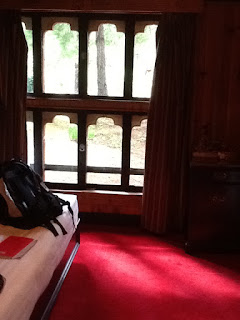
And then checked into our red carpeted cottages at Olathang Resort. This was the first hotel to be built when Bhutan opened its doors to tourism in 1974, and it has lost none of its charm.
Day 7 and it was time for the climax of the trip, our hike to Taktsang Monastery, or the Tigers Nest, which is perched way up on a cliff side in the Paro Valley and is where the legendary Guru Rinpoche (Padmasambava, who brought Buddism to Tibet and Bhutan) is said to have flown in on the back of a tigress and meditated in a cave there for three months.

It's an hour's steep walk to the teahouse and viewing point ( you can do this section on horse back) and then another hour to the monastery.

It's a great spot to view Tigers Nest and hikers have the option of continuing on to the next stage of the walk.

Paro Taktsang was shy at first, hidden in the mist.

But then the clouds parted and revealed her splendour.

At the end of the walk there are a thousand steps along the cliff face that take you down to the cave of Yeshe Sogyal ( Padmasambava's consort — it was she who transfomed her self into the tigress to bring him to this extraordinary place), and up to the Tigers Nest.

No gadgets allowed here either, no phones, cameras, not even pens or note books. There is even a mantra singing police man to frisk you as you enter.

We arrived in the small gonpa that has been built around Guru Rinpoches's cave (we could see the door to the cave that is rarely opened) and thirteen monks an their lama were doing a long life puja for the Queen Grandmother (she is a great supporter of the Dharma). Chanting and sounding the trumpets, drums and cymbals —it really is a deeply primordial sound. We visited other small temples, rang the big bell given to the monastery by the people of Kobe, Japan. Its sonorous tone sounded out across the valley and one could imagine the flight of the tigress with its valuable charge, and its arrival in the small gap in the rock our guide called the landing strip.

We lit butter lamps in a room next door and each made a wish. The lamps would burn on for 24 hours sending their smoke out into the mist that swirls around the Taktsang cliffs and up to the heavens.

Lunch time for the monks and the policeman meant closing time for us so we picked up our things from the locker room and started the climb down. A few of us visited the cave of Yeshe Sogyal just below, no time limits there.

We said some more prayers and wishes at her altar and took note of the sign, Quiet Please Hermit in Residence. In a small closed room built above the cave we imagined and old nun sitting with her prayer wheel sounding out her mantras as everyone here loves to do; the chef at our first hotel, the doorman with his deep low timbre and the police man we had just left behind.
On the way down some of us found time to write

others practcally skipped down the track

and while we may have just experienced the highlight of our trip, we knew it wasn't over yet.
To be continued...
More pics here
Read some of our writing here
We will visit Bhutan again in August 2016 to attend the Mountain Echoes Literary Festival and explore the valleys we didn't get to this time. All details here.
Jan Cornall leads international writer's workshops and retreats. Find out more here

We stopped in Kolkata but didn't get off, and not far past Mt Everest (yes this pic the real thing, not a mountain shaped cloud!) our small plane, imagining it was a helicopter, wound its way through a narrow steepsided valley (so close we felt we could reach out and touch the valley sides) and landed on the short runway at Paro airport.

Our guide Tenzin, tall, handsome and elegantly dressed in a traditioal goh, shook each of us by the hand and said in his slow, calm voice 'welcome to Bhutan.'

On the way to Thimphu, he took us to the famous chain bridge, one of 108 chain bridges built in the 1300s.

The river rushes beneath the chain mesh, not as easy as it looks to cross, but our gentleman guide was ready with a helping hand.

Thimphu is the capital of Bhutan and consists of a charming sprawl of houses and apartment buildings built along the Thimphu Valley. Mist hung low over the surrounding mountains giving the hill town a suitable air of mystery.


First stop was the Memorial Stupa, to join the locals in circumnabulation.


Next stop, the Takin Reserve. The takin is the national animal and looks like a cow with a goats head. It is said that when asked to perform a miracle, local saint, Drukpa Kunley (see more below) took the head of a goat and placed it on the skeleton of a cow, and so the takin was born..

After lunch we browsed the local shops and craft market...


On the second day of our writing workshops we were joined by Bhutanese writers Chador Wangmo, Pema Gyaltsen and Karma Norbu, Namgay and Sonam. One of our group Carolina, told of her journey to Bhutan in 1968, when Mrs Ghandi came to open the first sealed road.
 |
| Postcard circa 1968 |
Some of the other sights we visited were the impressive Trashi Chhoe Dzong where monks were reahearsing their mask dances for the festival in Sept.

And the sun broke through the misty clouds on our visit to the giant Buddha watching over Thimphu valley. In its final stages of erection it should be ready next year.

We were invited to come to Sonam and Pema's school to meet their students.

And we stopped in at a paper factory before lunch.

The Natonal Library was a treat...

But the highlight of the day was a visit to the School of Thirteen Arts. The college was is sponsored by the 5th King of Bhutan. Here tuition is free and students are instructed in the major arts and craft skills. Read more here.


On Day 4 we headed up and up along steep windy roads to Dochala Pass.

The pass was shrouded in mist so we missed the view of the Himalayas, but we could imagine...

We coasted down into the Punakha Valley to visit the temple of Drukpa Kunley, The Divine Madman. Known as a practioner of 'Crazy Wisdom' he loved women and ara (local wine) is still revered as an irreverant saint. Animated representations of his phallus adorn houses all over Bhutan as a symbol of fertility and women come from all over the world to take part in a fertility ritual at his temple.


Next day we visited the stunning Punakha Dzong, built at the confluence of the the confluence of the Pho Chun and Mo Chuu Rivers...
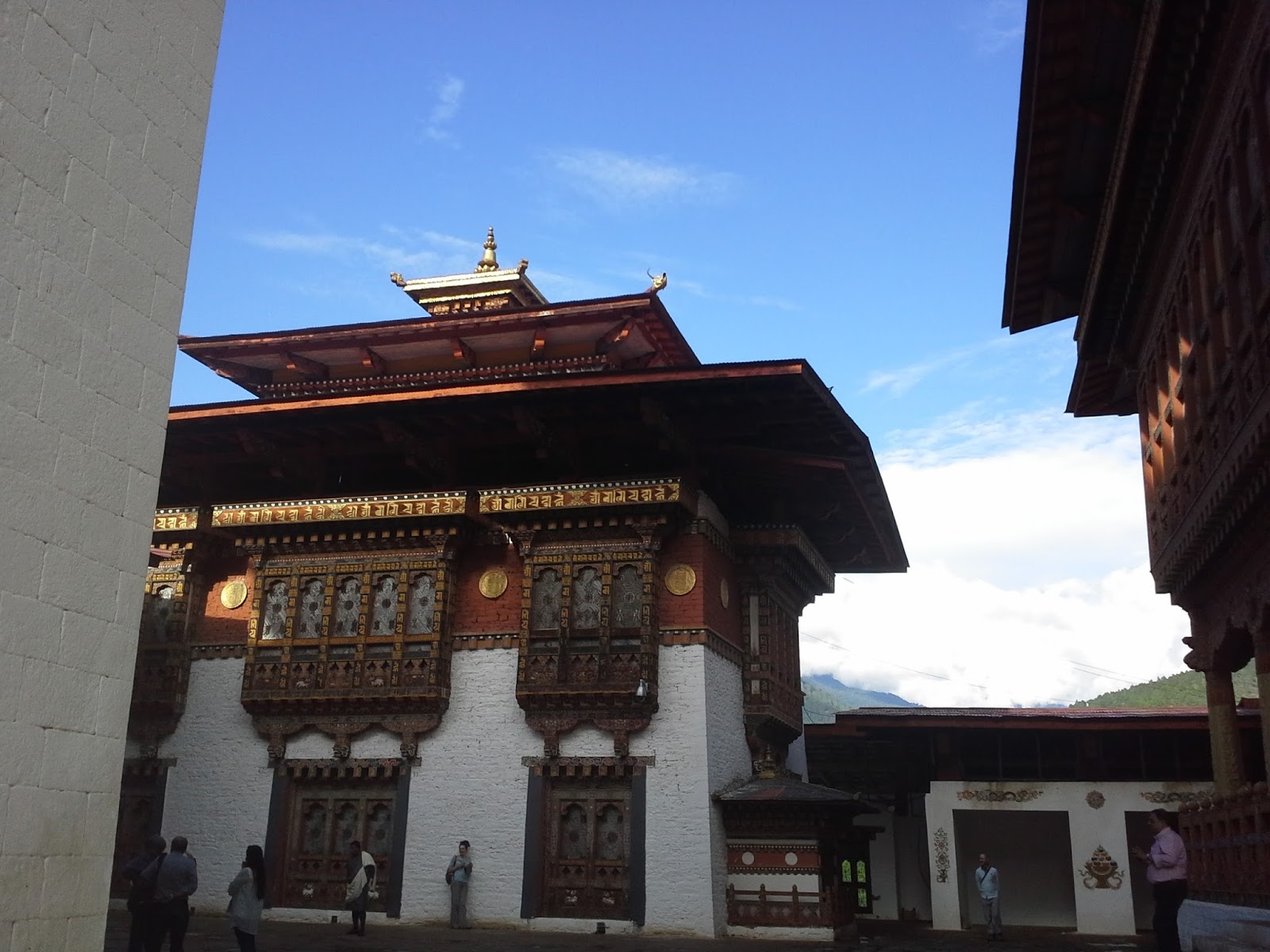
and hiked through the rice paddies to Khamsum Yulley Namgyel Chorten.

Inside was a treat for those of us who knew a little about Tantric Buddhism — four floors of sculpted wrathful deities and wall paintings (no photos allowed), with a spectacular view over the valley from the top.


We all agreed we could have spent an extra day in Punakha Valley.

Back over Dochala Pass and on to Paro, we visited Paro Dzong (no, we were not Dzonged out yet!)

And then checked into our red carpeted cottages at Olathang Resort. This was the first hotel to be built when Bhutan opened its doors to tourism in 1974, and it has lost none of its charm.

Day 7 and it was time for the climax of the trip, our hike to Taktsang Monastery, or the Tigers Nest, which is perched way up on a cliff side in the Paro Valley and is where the legendary Guru Rinpoche (Padmasambava, who brought Buddism to Tibet and Bhutan) is said to have flown in on the back of a tigress and meditated in a cave there for three months.

It's an hour's steep walk to the teahouse and viewing point ( you can do this section on horse back) and then another hour to the monastery.

It's a great spot to view Tigers Nest and hikers have the option of continuing on to the next stage of the walk.

Paro Taktsang was shy at first, hidden in the mist.

But then the clouds parted and revealed her splendour.

At the end of the walk there are a thousand steps along the cliff face that take you down to the cave of Yeshe Sogyal ( Padmasambava's consort — it was she who transfomed her self into the tigress to bring him to this extraordinary place), and up to the Tigers Nest.

No gadgets allowed here either, no phones, cameras, not even pens or note books. There is even a mantra singing police man to frisk you as you enter.

We arrived in the small gonpa that has been built around Guru Rinpoches's cave (we could see the door to the cave that is rarely opened) and thirteen monks an their lama were doing a long life puja for the Queen Grandmother (she is a great supporter of the Dharma). Chanting and sounding the trumpets, drums and cymbals —it really is a deeply primordial sound. We visited other small temples, rang the big bell given to the monastery by the people of Kobe, Japan. Its sonorous tone sounded out across the valley and one could imagine the flight of the tigress with its valuable charge, and its arrival in the small gap in the rock our guide called the landing strip.

We lit butter lamps in a room next door and each made a wish. The lamps would burn on for 24 hours sending their smoke out into the mist that swirls around the Taktsang cliffs and up to the heavens.

Lunch time for the monks and the policeman meant closing time for us so we picked up our things from the locker room and started the climb down. A few of us visited the cave of Yeshe Sogyal just below, no time limits there.

We said some more prayers and wishes at her altar and took note of the sign, Quiet Please Hermit in Residence. In a small closed room built above the cave we imagined and old nun sitting with her prayer wheel sounding out her mantras as everyone here loves to do; the chef at our first hotel, the doorman with his deep low timbre and the police man we had just left behind.
On the way down some of us found time to write

others practcally skipped down the track

and while we may have just experienced the highlight of our trip, we knew it wasn't over yet.
To be continued...
More pics here
Read some of our writing here
We will visit Bhutan again in August 2016 to attend the Mountain Echoes Literary Festival and explore the valleys we didn't get to this time. All details here.
Jan Cornall leads international writer's workshops and retreats. Find out more here


