Wednesday, September 25, 2013

Rice Field Recovery

 Updated 16/1/15
Jan Cornall's novel TakeMe To Paradise (Saritaksu) was launched at the Ubud Writers & ReadersFestival in 2006 and tells the story of Marilyn, a western woman arriving in Ubud a year after the first Bali bombing.


In the piece below, a mini sequel to the novel, Jan imagines Marilyn’s return several years on when Bali’s recovery is in full swing. 


RICE FIELD RECOVERY

You arrive.
And it’s not the same.
Where palm trees once swayed in the hot jet fuel breeze, bill boards have sprouted and taken hold; every little crack and cranny selling something, but not the thing you need

You need to recover, from what you’re not sure. It worked last time — last time you were soothed back to life by rice paddy green; all-around-you-green, everywhere-you-looked-green, as-far as-the-eyes-could-see-green. Now you have to cut your way through a forest of advertising, a mangle of metal, a sea of shiny fat bumper-to-bumper SUVs, joining you on your search for the pristine green sawah that will help you retrieve that something you think you have have lost - if only you knew what it was.

Last time you met a driver who took you in, took you home to meet his family, offered you a room. You felt so happy within the walls of his family compound, so well looked after, so safe every time you up and downed the steps of the traditional entrance gate to his house where all the slithering, ground traveling demon spirits couldn’t follow.

Then the whole island was in recovery, picking up the pieces after Bomb One, performing endless purification rituals and self-examinations and coming up with ingenious ways to convince the world that Paradise would be retrieved from the wreckage. And it was, just look around you, the place is booming, everything bigger and better than before; “even the Balinese are getting fat” you remark as you watch them rolling out the doors of the Hungry Jack/Kentucky Fried/Dunkin Donut/Macca’s fast food by-pass strip, trying to heft themselves onto their motorbikes. Where once you could fit a family of four, not even two fatties can fit.

“I’d rather eat babi guling any day,” your taxi driver chortles, “every day, if I could. The place might be booming but it hasn’t helped my pocket. I’m working three times as hard, stuck in the macet all day for same money as before, and then if some family member has to go to the hospital… well, it’s all over.”

You mutter some words of commiseration as your driver leaves the macet behind, taking the back roads through small fields and villages. You wind down the windows and let the smoke from afternoon gutter fires fill the car. Its carcinogenic fumes make your nostrils run and your eyes smart but you don’t care, it feels like coming home.

Last time you were recovering from the big one; the big break up, the big divorce, the one that left your outline filled with a thousand tiny holes, like someone had used you for target practice (you suspect that someone was you). Bali’s green patched you up, healed your scars, injected its chlorophyll into your veins through your eye-sockets. You went home with a new spring in your step, determined to do all the things you once said you would, no holding back this time, no holds barred.

Only now it seems that this idea of ‘living your dream’ has gotten much more complicated. Not only do you have to live it, but also blog it, boast it, crowd fund it, film it, sound-bite it, you-tube it, instagram it, win an award for it...

“Where did you say you want to go?” your driver asks.

“Kaja,” you reply, “kaja, as far north as you can go...”

“You want to go to Agung?” he laughs.

You remember fondly how kaja means to face the mountain and kelod to face the sea, but you tell him, “I just want to go to the sawah, the best duck-eating, bug-eating rice paddy you can find, where I can sit for a week or two and reclaim, recoup, re-calibrate, realign, repair, redeem, re-salvage, restore... a little bit of stillness to my over-mailed, over-tweeted, over-shared, overwrought, underdone dream life.”

Your driver grins in the rear-view mirror. He understands, as drivers always do.

“Oh, too much traffic in your brain - you got mind macet! Ok, we go north all the way, no macet there…my family lives in a small village near to Singaraja, they have small bungalow in the sawah - only you and the swallows.”

“Perfect,” you tell him, “no wifi?”

“No wifi.”

“Bagus sekali!” you exclaim as you lean out the window, drinking in the early evening cool, not in the least bit worried that once again you are putting your life in the hands of a complete stranger.

“What your name?” he asks. “I am Nyoman.”

“Marilyn,” you reply.

“And tonight Mar-a-lyn,” Nyoman adds,  “we have very important ceremony in our village temple. I am very lucky that your fare brings me home or I would not be able to attend. Would you like to come? You have kebaya? My wife has plenty, you can borrow...”

You reach into your bag and turn off your iPhone, iPad, iPod, stow them in a secret inner zip lock pocket and throw away the imaginary key.

Cold turkey in the sawah, for as long as it takes. If you run out of money you can always sell off your electronic devices one by one, or better still rent them out, that should keep you in nasi bungkus for a good few months. Maybe even start a support group, iAnon, “I am a recovering iAddict and I have not turned on any of my screens for seven days (everyone clap).”

One step at a time, one step at a time…

(c) Jan Cornall 2013


The Ebook version of Take Me To Paradise launches on Feb 3, 2015. Get your sample or copy here!


In July 2015 Jan will lead a Backstage Bali Writers Retreat 
Jan's most recent book is Archipelagogo - Love Songs to Indonesia.
Join an international writers retreat with Jan at  www.writersjourney.com.au

Thursday, July 18, 2013

Read, Write, Travel


Author Walter Mason interviewed me recently for his blog on reading, writing and travelling.
You can read all about it here

 On his blog Walter calls himself a writer, spiritual tourist and lifelong dilettante.
You an add to that: published author, blogger, networker, traveller, foodie, raconteur and all round lovely person.

He also has another blog with noted author Stepanie Dowrick, which I have had the pleasure of writing for a while back. The Universal Heart Bookclub.


Walter's next book will be out in September. Following the popular Destination Saigon, published in 2010, Allen and Unwin are bringing out Destination Cambodia.


From Allen & Unwin 

"Join intrepid traveller, Walter Mason - author of Destination Saigon - on a colourful adventure to one of the world's hottest new destinations. Meet taxi drivers, writers, hip -hop stars and monks as he traverses this extraordarily beautiful country. 

Walter Mason's distinctive voice, his upfront knowledge of Cambodia and wicked sense of humour meet in this riotous celebration of a remarkable and resilient nation, which has become a great tourist destination."

Walter has a number of events planned beginning in Sept, to celebrate the new book!
.


a writer, a spiritual tourist and a lifelong dilettante - See more at: http://www.waltermason.com/2013/07/jan-cornall-on-buying-books-abroad.html#sthash.Zvuc22YD.dpuf

Friday, July 12, 2013

The Hidden Gardens of Fes

During our Sacred Song, Sacred Story writing retreat in Fes, we were lucky to meet Heidi Vogels who is researching green spaces in Fes for her Fez Gardens documentary project; collecting stories, photos, information, history, artifacts, about the hidden gardens of Fes. Mostly contained within the four walls of a riad or traditional house (riad in fact means garden) they are indeed hidden from sight and many of the grand old gardens, like some of the palaces and riads that house them, have fallen into disrepair. With access that few tourists can gain, Heidi took us on a tour of some of these extraordinary gardens.


Heidi introduces the Fez gardens walk


Flower seller on the way. This flower is used as an insect repellent among other useful things.


These pots are typical Fes design. A local gardener Si Tayeb maintains the only remaining garden and orchard on the edge of the medina. He is standing strong against developers who want his garden for car park.


His assistant is 102 years old!


Peacocks are a common sight in Fes gardens.


Walking through his orchard was a sensual experience


with strong scents from the citrus trees and a family of cats.


On the way Heidi tells us how Fes is built on water- underground and above ground springs and rivers.


A hidden garden has a life of its own in this former palace.


The garden can be viewed  from all vantage points.


Oranges are everywhere in Fes


Another former palace - Palais Mokri , has a huge garden.


Forgotten and abandoned now.


Cyprus pines and fruit trees share the space.


It was thirsty work, Heidi's assistant handed out ripe green figs and time stood still.


Winding our way home past more hidden gardens.

Find out more about The Fez Garden Project.
This tour was part of our Sacred Song Sacred Story retreat.
www.writersjourney.com.au

Thursday, July 4, 2013

Sefrou, Morocco, a great little writer's residency


In the week following our writer's retreat in Fes, I had the best mini writer's residency at Sefrou, half an hour's drive out of town in a grand taxi.  Not long after I waved bye-bye to my dear writers with whom I had spent the most exhilarating fortnight, I found myself in a much smaller, quieter town. 


I only had a week but I could have easily stayed a month. My guest house Dar Attamani it turns out, was a former rabbi's home. I wonder if that's why I felt so peaceful and happy there.


My host Jess Stephens has her own place just around the corner, a gorgeous wee apartment with a roof garden and view of the river that rushes delightfully loudly through the centre of the medina.


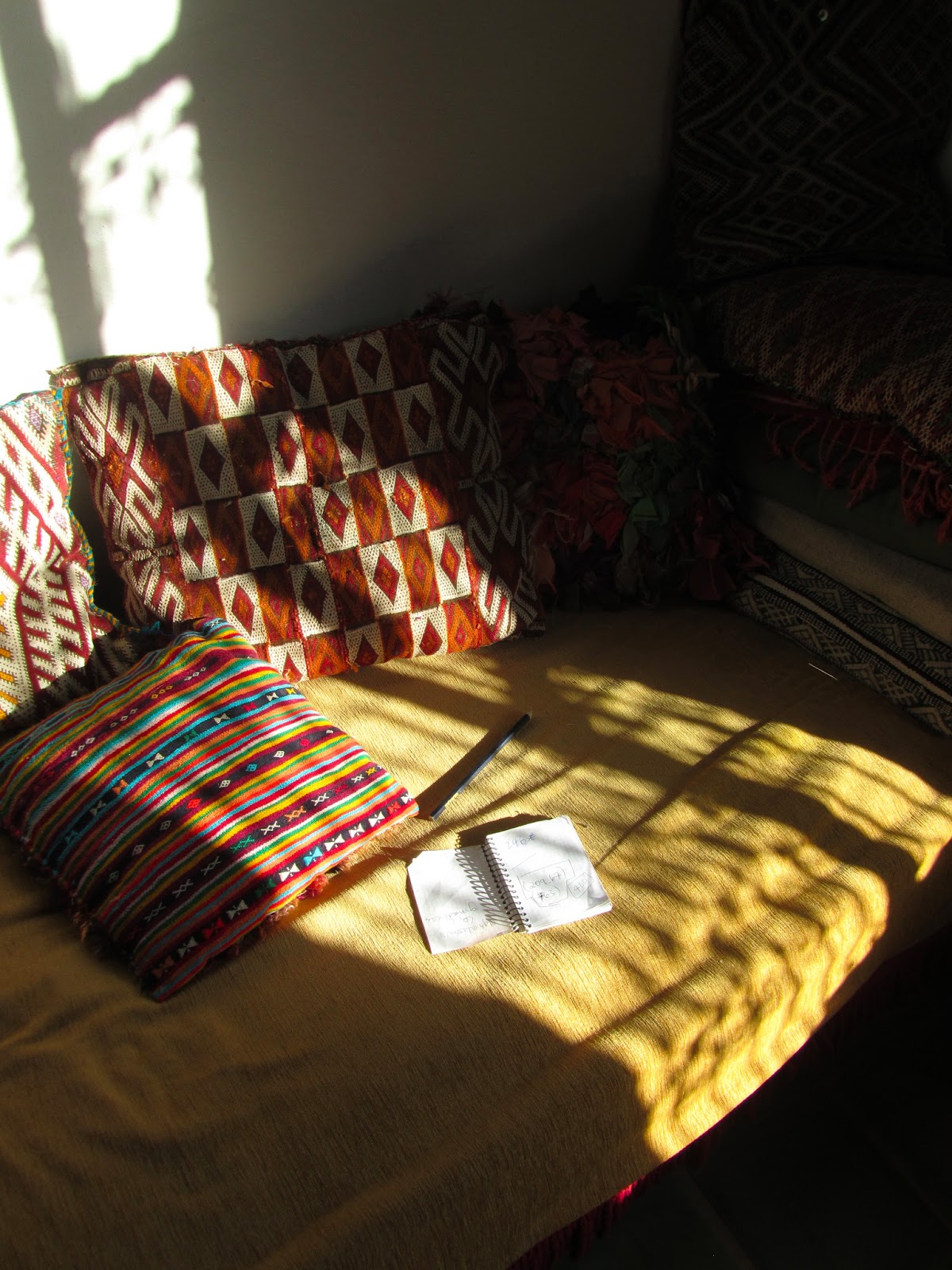
I got lots of work done, moving from writing table to divan to comfy bed to


 roof top terrace,


while storks were busy on their twiggy nests on every mosque minaret in sight,


not at all interested in my delicious meals cooked by Zeinab and staff.


 Jess popped in often to see how I was going, and to show me around town - we went country walking...


 with her dog Jasmina,


and 70 year old neighbour, Achmed.


The annual Cherry Festival was getting going in full swing on the last few days of my stay. It is Morocco's oldest festival - 93 years! There were cherries a plenty (no cherry pics), and also markets and craft displays,


a giant fun fair,


 even fairy floss,


big music events, including a showcase of traditional Berber singing and dancing,


and Fantasia!


I was imagining some kind of Disneyland affair but Fantasia is a horse riding event where a line of eight or so desert men (and one woman!) ride their gallantly decorated stallions full pelt at the audience for a few hunderd yards, discharging their muskets and coming to an abrupt stop before the excited crowd.


What a brilliant week. I will definitely be back for more! Thanks Jess and Culture Vultures!


Jan Cornall is a writer and performer who leads writer's retreats in Bali, Fiji, Laos, Burma, Morocco.
Find out more here
 

Wednesday, July 3, 2013

Getting to know the Gnawa Lila


In Fes last month, at the Sacred Music Festival, our writing group was lucky to receive an invitation to a private lila. The all night Gnawa Lila is a musical healing ceremony that has it origins in Africa's Western Sub-Saharan region, in countries like Senegal, Chad, Mali, Nigeria, and found its way to Morocco when slaves arrived in the sixteenth century. Gnawans consider themselves good muslims and Allah is praised in their songs along side the pantheon of muslim saints and Afro Saharan tribal spirits. Disapproved of by Muslim conservatives, Gnawa music and its rituals they are popular in all parts of Morocco.

We weren't permitted to take photos and it didn't feel right anyway, so I have assembled some sourced pics and clips to give you an impression of our experience.


We assembled at the given address at 10pm. I wasn't far from the main Sufi venue on a street we'd been walking along each night on our way to the main concerts at Bab al Makina ( Royal Palace entrance) and Bab Bou Jeloud (The Blue Gate). We were ushered into two small adjoining rooms with very high ceilings. The inner room had couches and cushions, the main room had a couple of couches, a step to sit on, an area where the musicians would sit, and a small kitchen at the back.


A mixed combo of Europeans, Moroccans and us were gathered, waiting for what, we weren't quite sure. Soon, outside, a loud insistent clashing and crashing rhythm began, punctuated by deep drum beats. Six (or so) musicians entered, dressed in gold edged blue gowns and hats with long tassles. In the centre of the small room they played, danced and performed acrobatics, never missing a beat as the compulsive rhythm built louder and (almost unbearably) louder. If this was to be a healing you felt that any bad spirits dwelling in your body would certainly be driven out right now, just to get away from the ruckus. After some brilliant high kicks, dangerous leaping and impressive tassle twirling, the musicians took their seated places along the wall in the small carpeted area allotted to them.


Pic from The View From Fez


In the first of many breaks to come, mint tea and nibbles were served as preparations were made for the next part of the ceremony. A young woman appeared, dressed in long white gown
(jelaba), bringing offerings which she placed in front of the musicians of different kinds of incense, herbs, a small ceramic jar containing burning coals, some fruit, and snacks.


When the musicians began again with the loud clashing rhythm of the double metal castanets (qaraqeb), accompanied by a stringed instrument (guimbri), she positioned herself in front of them and began her dance. With feet parted but well planted on the floor, arms clasped behind her, she moved the upper part of her body throwing her head from side to side in a move reminiscent of head banging fans at a heavy metal concert.This is how, we were told, she would enter into trance.


www.photocrati.com

 And indeed she did for as the night wore on she took the burning coals in her mouth, cut herself with a carving knife, drawing no blood (well, just a tad), burned her arms and throat with candle flame and generally tranced out, joined at different stages by other young friends who also seemed to be able, at the drop of a hat, to go into trance and come out again for a cigarette or conversation with friends.

 There were different costume changes in each break as she changed into the colours of the different spirits being evoked, different offerings, different incense, and different snacks to keep us awake.  A bowl of milk was passed around for us all to drink followed by a bowl of sweet dates. Orange blossom water was splashed our heads like holy water, and later yet more:  thick black coffee, pancakes and Moroccan spring rolls. Despite the abundance of sustenance, at one point I did succumb to sleep, head leaning on a mosaic pillar but woke again as the crashing rhythms built to yet another climactic pitch.


After three or four sessions and three or four breaks, when it looked like the more serious business was over, more people from around the edges joined in the dancing, several westerners being berated by an older gentleman guest, "don't wiggle your hips, dance from the shoulders!" It was wonderful to move at last and feel the clash-clash rhythm rip through your body.

But it was getting very late and we had a workhop scheduled for the morning. I tried to gather our group from various positions on couches and pillars and even managed to get them out the door, when the hostess insisted " Oh, but there's only one more session to go and you must stay - they will call up Aisha Kandisha!' Aisha was also the name of our wonderful guide and hostess at our hotel Riad Rcif, and when she told me, "I've never stayed to the end before and I've always missed the Aisha invocation," we filed back in and hit the dance floor for the last bracket.

 I lost track which colour the young dancer had changed into but in my imaginings it was earth greens and rich browns. Aisha Kandisha, we were to find out, has a powerful presence in Morocco. Women make secret offerings to her and she is invoked in many different kinds of ceremonies including a pilgrimage to her sacred spring near Sidi Ali. Read more here.

incense kit (with lizard) used for invoking Aisha Kandisha

 Finally the night was over. It was 5.30 am, not quite dawn, when we made our way home through the medina, refusing the final offer of hot lima bean soup and bread from our generous hostess. For the musicians it was the end of another long night, for the dancers - a powerful healing, and for us, an unforgettable taste of a primal and ancient, mystical world, that some of our group were happy to leave at that,  and others knew they would have to have more!

Jan Cornall
Writer's Journey


APPENDIX

The Seven Stages of Lila

This informative explanation on the stages of Lila comes from Deborah Kapchan of Penn Museum

"The Lila itself is a long complicated ritual in seven parts, one for each Mlouk. Mlouk refer to powerful spiritual entities that reign over the lesser spirits called Djinns. According to the Gnawa every person resonates with a certain Mlouk, and each spirit, or family of spirits, has a color, an incense, and a food or drink. For each of the seven sections the Gnawa wear color appropriate costumes, burn the associated incense, serve the corresponding food, and play the particular melody associated with the Mlouk.

In my research I have come across many accounts of how western terminology simply cannot encapsulate the feeling of communal heightened awareness and emotion of the trance state that occurs during the Lila.

We can throw around the word “trance”, but such an experience is so foreign to most Westerners that it really has no substantiated meaning, and in addition we do not have words in our vocabulary to even properly describe the feeling of trance. What can be said is that during the Lila participants, when communicating with their Mlouk, experience a gamut of extremely heightened emotional states; people scream, cry, laugh hysterically, experience bliss, eros, terror, and many other extreme emotions.

While in a trance, and somewhat afterward, participants have the feeling of being “somewhere else”, another dimension of sorts, transcending both time and space.

The ceremony traditionally goes through each of the seven sections. Although the order of the Mlouk varies from place to place, the Lila often begins with the White suites (representing male) and ends with the Yellow suites (representing female, or rebirth).

The White Mlouk is AbdelKadder Jilani, an 11th century saint. He is said to be the “sultan of saints”, the “standard bearer of the Way”. He opens the door to the spiritual world.
The multi-colored suite invokes Bourdebela, a Master Mystic beggar. This Mlouk is thought to be part of the cohort of the whites.

The Blue suites are in honor of Sidi Mousa (Moses), the Lord of the Sea (dark blue), and Sidi Sma, the Lord of the Sky (light blue).During this section the trancer dances with a bowl of water with mint leaves on their head.

The Mlouk of the Red suite is Sidi Hammou, the master of the slaughterhouses. This Mlouk is wild and fearsome. In this section the trancers dance with daggers, sometime cutting themselves while in possession.


The Green suite is in honor of the descendants of the prophet. The Maalem begins by invoking the Prophet and then various local saints known to be his decendants.

The Black Mlouk are the Djinns of the forest, Sidi Mimoun and Lala Mimouna (male and female), and are the most dangerous and wild of all. During possession adepts can morph into animals, eat raw flesh, and sometimes even attack the audience.

Finally the Yellow suite is dedicated to all of the female spirits, whose Mlouk is Lala Mira. During this section sweets and perfume are given to the trancers, and adepts are known to feverishly devour the candies." Deborah Kapchan, Moroccan Gnawa and Transglobal Trance.

Below is a clip of a Red suite

'Red" Still from You Tube clip by Peter Danstrup. 
Watch the clip here with renowned sentir player Mustapha Baqbou


Read article here on from the View From Fez - Night Music - African Americans and Gnawa Music.

NOTE: The two small white boxes that have found their way onto this page and cannot be erased remain as a reminder of the presence of the spirit world discussed in this article. Bismillah!

SACRED SONG, SACRED STORY Writer's Retreat will take place in Fes in 2014. June 12-22. Booking now